
Knit-In vs. Sublimated Custom Socks: What's the Real Difference?
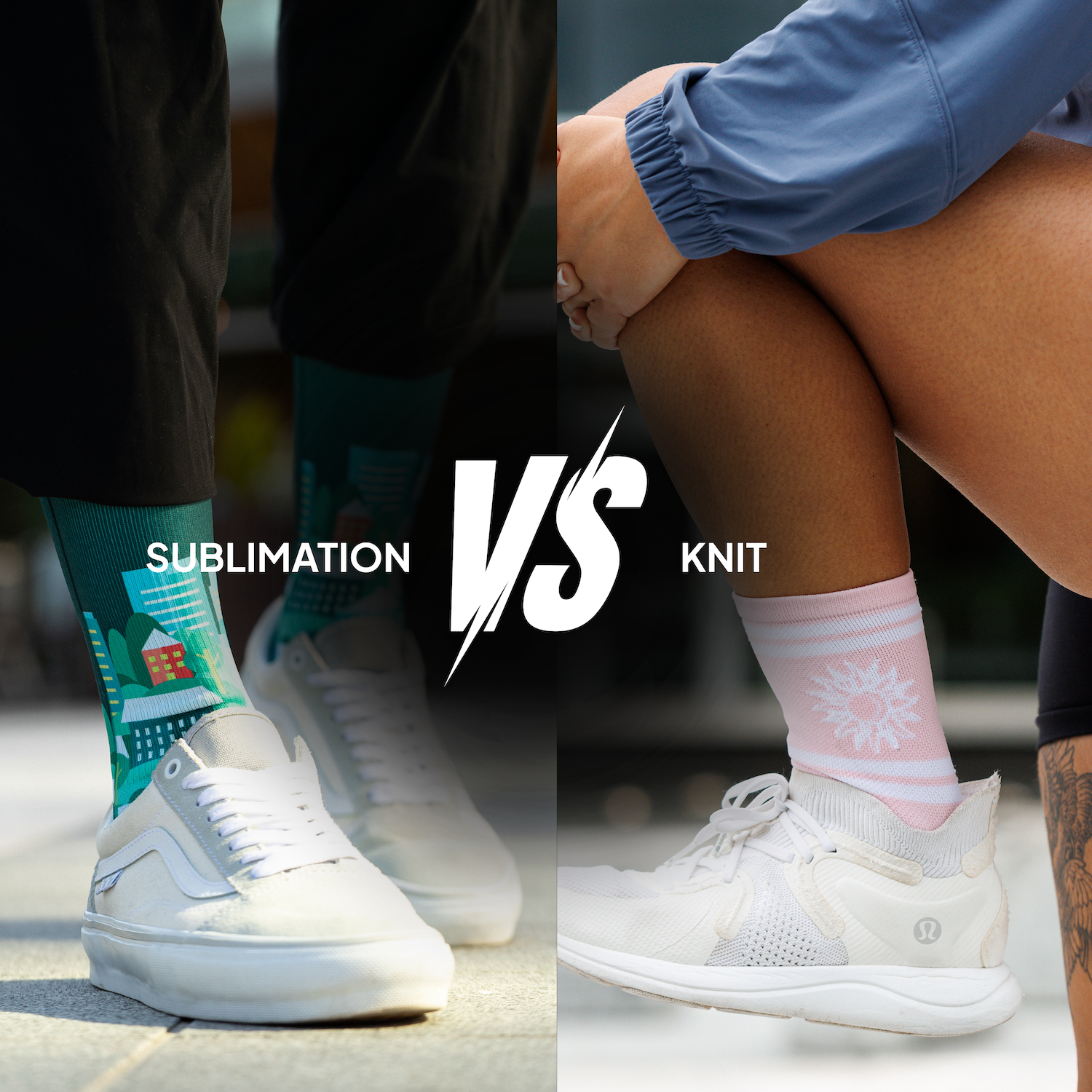
If you've gotten far enough into custom sock research to be asking this question, you're past deciding whether to order and into deciding how. Knit in and sublimated are the two primary production methods you'll see when comparing custom socks. (You may also see sublimated socks referred to as "printed" socks.) They produce genuinely different products, not just different price tags. Here's the real difference and how to pick the right one for your project.
Knit In vs. Printed Custom Socks: How Each Method Actually Works
Knit in socks, also called jacquard knit socks, build the design into the sock itself. The knitting machine is programmed to switch between pre-dyed yarns row by row as the sock is constructed, so your logo, colors, and pattern come from yarn structure, not a surface coating applied afterward. The design is quite literally part of the fabric.
Sublimated socks work differently. The sock is knit first using a white polyester or polyester blend base. Your design is printed onto transfer paper, then applied to the finished sock using heat and pressure. During this process, called dye sublimation, the ink turns into a gas and bonds directly with the polyester fibers instead of sitting on the surface like traditional printing. The result is a permanent, full colour design that's built into the fabric rather than layered on top.
Cost Per Pair: Knit In vs. Sublimated Custom Socks by Quantity
At Custom Lab, pricing is quantity based rather than split into separate knit in and printed price lists (see our full pricing breakdown for more), and the minimum order is 30 pairs per design regardless of method.
- 30 to 125 pairs: roughly $12 to $17 per pair (CAD), with basic packaging included.
- 125 to 250 pairs: improved pricing, with custom branded belly bands.
- 250 to 500 pairs: roughly $9 to $12 per pair.
- 500 to 1,000 pairs: volume pricing with a dedicated support contact.
- 1,000+ pairs: our best available rate, priority production, and physical samples included ahead of your full run.
All quotes include shipping, with no design fees, revision charges, or tooling costs.
Where the method itself affects cost, industry wide, is setup. Jacquard knitting requires the machine to be programmed for your specific pattern, a fixed cost that becomes more economical as volume increases. Dye sublimation has a lighter setup requirement, which is part of why it appears more often on very small or one off runs elsewhere in the market. In practice, we factor all of that into a single quote based on your design and quantity, so you don't need to compare the two methods separately.
Design Fidelity: Color and Detail Limits of Knit In vs. Printed Custom Socks
This is usually the deciding factor before cost ever enters the conversation.
Jacquard knitting is built for bold, graphic designs: wordmarks, icons, stripes, and repeating patterns in a handful of solid colors. Smooth gradients and photographic detail don't translate well to yarn. The machine works in discrete color blocks, so very fine text or subtle gradients tend to lose crispness. Our artwork guide covers what file types and detail levels work best for each method.
Sublimated socks have no such ceiling. Because the design is printed rather than knitted, you get full color artwork, gradients, and even photo realistic imagery with no practical limit on the number of colors. If your logo includes a gradient, a photograph, or intricate fine detail, dye sublimation is the only method that will reproduce it accurately.
Durability and Wash Life: Which One Holds Up Longer
Knit in socks tend to win on long term durability for a simple structural reason. The color is the yarn, not a coating applied on top of it. There's nothing to crack, peel, or wear away at the surface, so the design holds up to years of regular washing and wear about as well as the rest of the sock.
Sublimated socks offer excellent durability. Because the dye bonds directly with the polyester fibers rather than sitting on the surface, the design won't crack or peel like traditional screen printing. However, because the color still lives at the fiber's surface rather than running through the yarn, it's more prone to gradual fading over many wash and dry cycles than a knit in design, particularly with high heat drying. Sublimation also requires a polyester heavy fabric to take the dye, which changes the hand feel compared with the cotton or merino blends available with knit in socks.
Knit In vs. Printed Custom Socks: How to Choose by Use Case
One-time events: Giveaways, conference swag, fundraisers, and promotional campaigns are often best suited to sublimated socks. They offer complete design freedom, making them ideal for detailed artwork and full colour branding. Although the print will slowly fade with years of repeated washing and wear, sublimated socks hold up well in everyday use and are more than durable enough for promotional merchandise, retail, and event giveaways.
Long term team or retail gear: Uniform socks, a year round retail line, or anything employees or athletes will wear and wash weekly is a better fit for knit in. A team crest or wordmark rarely needs more than a few solid colors, and the durability difference compounds over dozens of wash cycles. Our guide for schools and sports teams walks through ordering for exactly this kind of recurring, long wear application.
Either way, the process is the same on our end. Submit your logo (vector AI, EPS, or SVG is ideal; PDF, PNG, or JPEG also work), your Pantone colors or hex codes, and a rough direction. We'll come back with a first concept, including a method recommendation, within one business day.
Frequently Asked Questions
1. Is knit in or sublimated better for a logo with a gradient or photo?
Sublimated. Dye sublimation reproduces gradients, photographs, and intricate artwork with virtually no color limitations.
2. Does Custom Lab offer both knit in and sublimated custom socks?
Yes. We'll recommend the method that best fits your artwork and use case during the design process, and nothing goes to production until you approve a digital mockup.
3. Does the production method change the minimum order or lead time?
No. The minimum is 30 pairs per design either way, and both methods follow the same production timeline: one business day for your first concept, one to three business days per revision round, 10 to 15 business days for production, and two to five business days for free express delivery – all in all about three weeks from request to delivery.
4. Which method costs less?
It depends more on your quantity than on the method itself. Our pricing runs from roughly $12 to $17 per pair at 30 to 125 pairs down to $9 to $12 per pair at 250 to 500 pairs, with volume pricing above that. We quote one price based on your design and quantity rather than charging extra for one method over the other.
5. Can I switch from sublimated to knit in (or vice versa) after I submit my design?
Usually, yes, especially early on. Since revisions are unlimited and free, and nothing goes to production until you approve the mockup, we can show you both a knit in and a printed version before you commit to either.
Ready to see it for your brand? Submit a free design request and get your digital mockup back in one business day.
Related blogs
.png)

Get your free digital custom sock design today
